

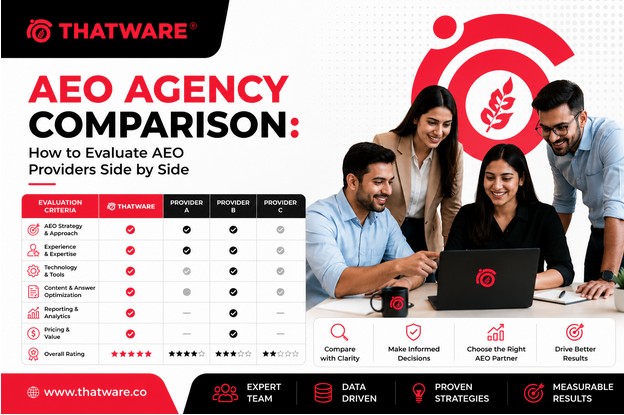
If you’ve reached the stage where you’re actively comparing AEO providers, you’ve already done something right: you’ve recognized that answer engine optimization is worth investing in. The harder part — and honestly, the part most buyers underestimate — is figuring out how to compare agencies in a space where the terminology is new, the metrics are evolving, and everyone sounds roughly the same in their pitch decks.
Here’s a practical framework for cutting through that.
Why Standard Vendor Comparison Doesn’t Work Here
With most marketing services, comparing vendors is relatively straightforward. You look at pricing, scope, deliverables, team credentials, and client references. You ask for case studies. You check reviews.
AEO is harder because:
The category is young, which means even credible agencies may not have extensive case studies yet. The results are less immediately measurable than, say, paid search or email marketing. The methodologies vary significantly across firms — what one agency calls AEO looks nothing like what another does under the same label. And the AI search landscape itself is moving fast enough that even well-designed programs need to adapt frequently.
None of this means you can’t make a good decision. It just means you need a more sophisticated comparison framework.
Dimension One: Methodology Clarity
Ask every agency you’re evaluating to explain, in plain language, how they approach building AI citation authority for a brand. Not in slide-deck language. In a real conversation.
What you’re listening for: a clear, logical explanation of how they think about content structure, entity optimization, and off-site signals. Specific answers about how they approach different AI platforms (Google’s AI Overviews vs. ChatGPT vs. Perplexity). An honest acknowledgment of what they don’t yet know — because anyone claiming to have AEO fully figured out is either overconfident or uninformed.
What’s a red flag: generic answers that could apply to any content marketing engagement. Heavy reliance on jargon without substance behind it. Claims that their approach is proprietary without any ability to explain the general principles.
Dimension Two: Technical Capability
AEO agency comparison exercises should include a real assessment of technical depth, not just content and strategy capability.
Does the agency understand schema markup and how structured data helps AI systems interpret content? Can they speak to knowledge graph signals — how brands become recognized entities in systems like Google’s Knowledge Graph or Wikidata? Do they understand how LLMs retrieve information at inference time vs. how they incorporate information from training data? These are not obscure technical questions. They’re foundational to actually doing AEO well.
You don’t need to be a technical expert to evaluate this. You just need to ask the questions and listen to whether the answers are substantive or evasive.
Dimension Three: Content Quality Signals
AEO is ultimately a content discipline. The agency’s ability to produce high-quality, authoritative, question-oriented content is the engine that makes everything else work.
Ask to see content samples from similar industries. Look for depth and specificity, not just length. Ask how they approach subject matter expertise — do they use specialists, interview clients, do original research? Ask how they ensure factual accuracy, which matters more for LLM credibility than for traditional SEO.
Volume is not a proxy for quality in this space. An agency that produces 50 excellent, deeply researched pieces will outperform one that churns out 500 superficial articles.
Dimension Four: Measurement and Reporting
This is where a lot of AEO agencies are still figuring things out — and where the honest ones will admit it. AI citation tracking is genuinely hard. There’s no clean dashboard that tells you “your brand appeared in 247 AI answers this month.”
But that doesn’t mean measurement is impossible. Ask agencies how they track: brand mention frequency in AI-generated outputs, appearances in Google AI Overviews for target queries, correlation between their program’s activities and downstream business outcomes. The best agencies will have a working framework for this — imperfect but directional. The less sophisticated ones will gesture vaguely at “monitoring AI mentions” without any systematic approach.
Dimension Five: Industry Fit
The AEO services reviews that matter most are the ones from clients in industries similar to yours. AEO strategy looks different in healthcare (where regulatory constraints shape what you can say), fintech (where trust signals are paramount), SaaS (where use-case specificity drives citation), and e-commerce (where product-level optimization matters).
An agency with no track record in your industry isn’t necessarily the wrong choice, but the burden of proof is higher. Ask them specifically how they’d adapt their approach to your category’s unique constraints.
Building Your Comparison Matrix
Once you’ve gathered information across all five dimensions, building a side-by-side view is straightforward. Score each agency on: methodology clarity, technical depth, content quality, measurement maturity, and industry fit. Add pricing as a separate row. Then look at the total picture.
The goal isn’t to find the agency with the highest average score. It’s to find the agency that scores strongest in the dimensions that matter most for your specific situation — and where any gaps are acceptable given the tradeoff.
One More Thing
Don’t underweight the relationship dimension. AEO is not a quick-win play. It’s a sustained investment in building genuine authority across the AI information ecosystem. The agency you choose will be a strategic partner — sometimes with aligned views, sometimes with challenging perspectives.
How they communicate, how they handle uncertainty, how they respond to questions they don’t immediately have answers to — all of that matters for a long-term engagement. The best comparison exercise includes enough conversation to get a real sense of the people, not just the pitch.
Choose accordingly.